

Privacy window film blocks the view into your home or office while still letting daylight in. Reflective films give one-way privacy during the day, while frosted, opaque and blackout films give privacy day and night. We help St. Louis homeowners and businesses match the right film to each room, with free on-site estimates.
How privacy window film works
Privacy film is applied to the inside of your existing glass. It works in one of two ways: by reflecting light so the glass looks like a mirror from the brighter side, or by diffusing light so shapes are blurred from both sides. Which one you need depends on when you want privacy and whether you still want a view out.
Unlike blinds or curtains, film stays put. You keep your daylight, your windows stay clean-lined, and there is nothing to open or close. Most privacy films also block up to 99% of UV rays.
Signs you need privacy film
- You keep blinds closed all day just to stop people seeing in.
- A neighbor's house sits a few feet from your side windows.
- Your front room faces a busy sidewalk or street.
- A bathroom window has clear glass, or a front door has clear sidelights.
- An office conference room or exam room is visible from a hallway or parking lot.
Privacy film options
Reflective (one-way mirror) film
Reflective film looks like a mirror from the brighter side. During the day, people outside see their reflection while you see out. The honest catch: at night, when your lights are on and it is dark outside, the effect reverses and people can see in. Reflective film is great for daytime privacy and heat control, but it is not a night-time privacy solution on its own.
Dark and dual-reflective film
Dual-reflective films are reflective on the outside and darker, less mirrored on the inside. That makes the interior view more comfortable at night and still adds strong daytime privacy. Darker tints reduce how much can be seen in daylight but share the same night-time limitation.
Frosted and opaque film
Frosted film gives the look of etched or sandblasted glass. It lets soft, diffused light through while blurring shapes in both directions, so it works 24 hours a day. Opaque white films block views completely while still glowing with light.
Gradient film
Gradient films fade from frosted to clear. They are popular when you want privacy at eye level but want to keep sky views or daylight at the top of the window.
Blackout film
Blackout film blocks nearly all light and view. It is used for media rooms, bedrooms for shift workers, storage areas and windows that face a wall.
Privacy films compared
| Film | Day privacy | Night privacy | Light let in | Look |
|---|---|---|---|---|
| Reflective / one-way mirror | High | Low (reverses with lights on) | Moderate | Mirrored outside |
| Dual-reflective / dark | High | Low to moderate | Low to moderate | Reflective outside, darker inside |
| Frosted | High | High | High (diffused) | Etched glass |
| Opaque white | Full | Full | Moderate (diffused) | Solid white glow |
| Gradient | High at frosted zone | High at frosted zone | High | Frosted fading to clear |
| Blackout | Full | Full | Almost none | Solid dark |
Still deciding? Our guide to the best window film for daytime and nighttime privacy walks through each option room by room.
Where privacy film works best
In the home
- Bathrooms: frosted or opaque film for privacy that never needs adjusting.
- Street-facing front rooms: reflective film for daytime, or gradient film to keep the top clear.
- Bedrooms: frosted on lower sashes, or blackout for full darkness.
- Close-neighbor side windows: frosted film keeps light coming in while blocking the view across.
- Sidelights and front doors: frosted or patterned film so no one can see into your entry. Our decorative and frosted window film page covers pattern options.
Privacy is often part of a bigger home project. See our residential window tinting services for heat and glare control on the rest of the house.
In the office
Conference rooms, exam rooms, HR offices and ground-floor workspaces all benefit. Frosted bands or full frosting on glass partitions keep meetings private without closing off the space. Learn more about commercial window tinting for the whole building.
Privacy in St. Louis homes and businesses
Many older neighborhoods in St. Louis City, University City and Webster Groves have homes built close together, so side windows often look straight into a neighbor's. Front rooms near the sidewalk and glass front doors are common requests. In Kirkwood and Brentwood, homeowners often want privacy on street-facing windows without losing daylight.
Our hot summer sun also matters. A reflective privacy film on a west-facing front window can cut afternoon heat and glare at the same time. For bathrooms and bedrooms where privacy matters after dark, frosted film is the safer choice.
Many homes in older parts of the region still have original single-pane glass. Privacy film works well on it, and on most modern double-pane windows too, but some dark or highly reflective films are not a fit for every glass type. We check your glass during the estimate and only recommend films that are compatible with it.
Our installation process
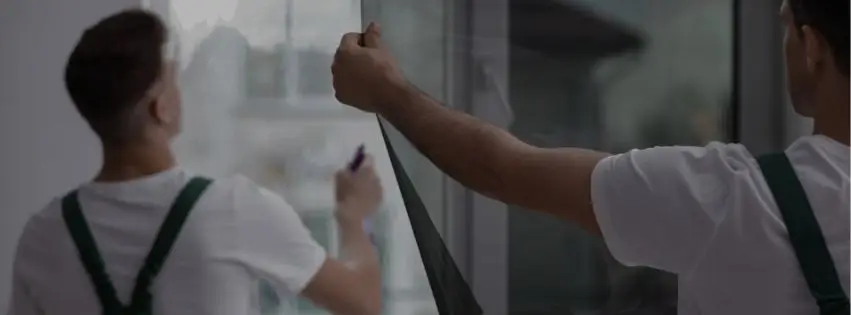
- Estimate and samples on your glass. We come to you, measure each window and hold samples up so you can see the privacy and light level in daylight.
- Film choice with spec sheet. We explain day and night privacy for each option and show you the spec sheet (VLT, TSER, glare reduction).
- Glass prep and cleaning. Each pane is cleaned and scraped so the film bonds evenly.
- Precise install and edge trim. Film is applied, squeegeed and trimmed tight to the frame for a clean finish.
- Cure time and care instructions. Some haze is normal while the film cures. We leave you simple care instructions.
What affects the cost
Price depends on the number and size of windows, the film type (decorative and specialty films often cost more), glass access, and whether old film needs removal. See how much home window tinting costs for a breakdown of factors.
Care, lifespan and why hire a pro
Clean privacy film with a soft cloth and ammonia-free cleaner, and skip abrasive pads. Quality film lasts many years. Ask about our lifetime warranty. Our work is guaranteed to last — if it isn't, let us know and we'll make it right.
Frosted and reflective films show every flaw. Dust, bubbles and crooked edges are easy to spot on a uniform surface, which is why a professional install matters most on privacy film. Schedule a free estimate and we'll bring samples to your door.
Frequently Asked Questions
Does one-way mirror window film work at night?
Not fully. Reflective film gives privacy when it is brighter outside than inside. At night, with lights on indoors, the effect reverses and people outside can see in. For privacy around the clock, frosted, opaque or blackout film is the better choice.
What is the best privacy film for a bathroom window?
Frosted or opaque film is usually best for bathrooms because it blocks views day and night while still letting soft light in. It looks like etched glass and needs no blinds. Gradient film is an option if you want the top of the window clear.
Can I still see out through privacy window film?
With reflective and dual-reflective films, yes, you can see out during the day while outsiders see a mirror or dark finish. With frosted and opaque films, the view is blurred or blocked in both directions. We show you samples on your own glass so you can judge the trade-off.
Will privacy film make my room dark?
Frosted films let a good amount of diffused light through, so rooms stay bright. Reflective and darker films reduce more light, and blackout film blocks it almost completely. Light transmission varies by film, and we show you the spec sheet before you choose.
Can privacy film be removed later?
Yes. Window film can be professionally removed without damaging the glass, which makes it a good fit for renters or anyone who may change the look later. Removal takes care and the right tools to avoid leaving adhesive behind.
Does privacy window film also block UV rays?
Most quality privacy films block up to 99% of UV rays, which helps protect floors, furniture and artwork from fading. Reflective privacy films also reduce solar heat. Exact performance varies by film.