
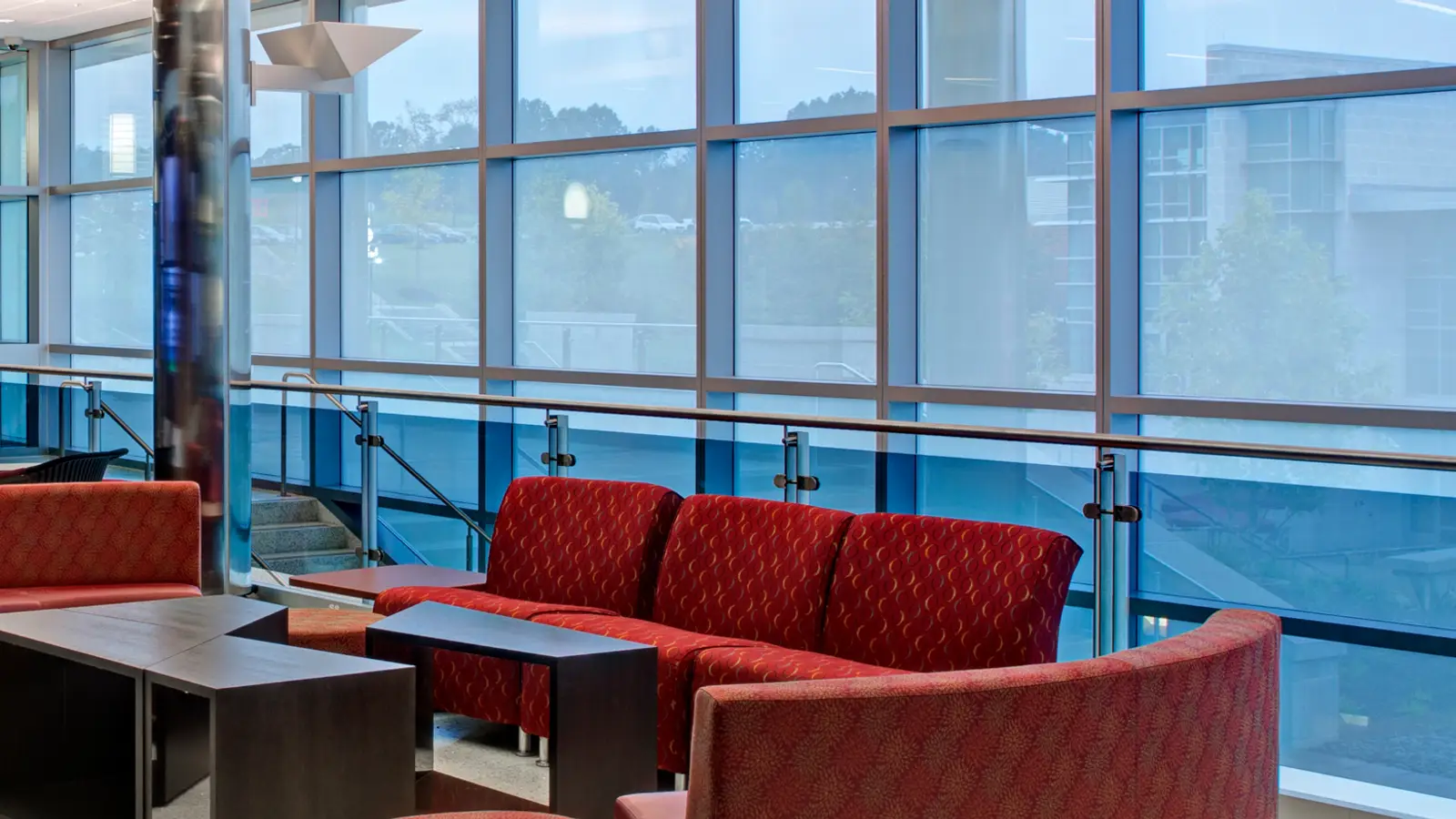
Commercial window tinting is a thin film applied to the inside of your building's existing glass to cut solar heat, glare and UV fading, add privacy, or improve how the building looks from the street. In St. Louis, it is one of the fastest ways for offices, storefronts, restaurants and clinics to fix hot spots and screen glare without replacing windows. We offer free on-site estimates across St. Louis City and County.
What commercial window film does
Commercial window film is a multi-layer polyester film adhered to the interior surface of the glass. Depending on its construction, it can reflect or absorb solar energy, filter out up to 99% of UV rays, soften glare, hold glass together if it breaks, or turn clear glass into frosted or branded glass.
Because it goes onto the glass you already have, there is no demolition, no new frames and no long construction schedule. Most projects are measured in days, not months. Performance varies by film, so we show you the spec sheet (TSER, VLT, glare reduction) before you choose.
Problems commercial film solves
Most business owners and property managers call us for one of a handful of reasons:
- Hot and cold spots. Offices along south- and west-facing glass overheat in the afternoon while interior rooms stay cool, and the thermostat fight never ends. Solar heat control window film evens out those zones.
- Glare on screens. Staff squinting at monitors, blinds closed all day, and point-of-sale or menu screens washed out by direct sun.
- Fading merchandise and finishes. Storefront displays, flooring, upholstery and artwork that fade in the sun. Our UV and fade protection film blocks up to 99% of UV.
- Privacy. Conference rooms, exam rooms, HR offices and ground-floor workspaces that face a sidewalk or parking lot.
- Security and safety. Ground-floor glass, glass doors and storefronts where you want broken glass held in place.
- Curb appeal. A mismatched mix of tinted and untinted panes, or a dated facade that needs a uniform, clean exterior look.
Commercial film types compared
Most commercial projects use more than one film: one for heat and glare on the sunny elevations, another for privacy or decoration on interior glass. Here is how the main categories compare.
| Film type | Heat control | Glare control | Privacy | Look | Best for |
|---|---|---|---|---|---|
| Reflective (silver or neutral) | High | High | Daytime one-way | Mirrored exterior | Office towers, west-facing facades |
| Spectrally selective / ceramic | Moderate to high | Moderate | Low | Nearly clear to light tint | Storefronts, lobbies, buildings with view or signage concerns |
| Dual-reflective | Moderate to high | High | Daytime | Reflective outside, darker inside | Offices wanting less interior mirror effect at night |
| Security / safety film | Low unless combined | Low unless tinted | Low unless tinted | Clear or tinted | Ground-floor glass, doors, schools |
| Decorative / frosted | Low | Moderate | High, day and night | Etched glass, patterns, logos | Conference rooms, partitions, entry doors |
For a deeper look at how these films differ, read our guide to ceramic vs. dyed vs. reflective window film.
Where we install commercial window film
Offices and multi-tenant buildings
Office glass is where heat and glare complaints pile up. Film can make perimeter offices usable again and give a building a consistent exterior look floor to floor. For property managers, we can match film across suites so the facade stays uniform as tenants come and go.
Storefronts and retail
Retail windows need to stay inviting while protecting what is behind them. Lighter spectrally selective films cut UV and heat without hiding your displays, and frosted bands or decorative window film can add branding to doors and transoms. Ask us about custom cut designs.
Restaurants
Diners near west-facing windows at dinner time feel it first. Film reduces harsh sun and heat at the tables while keeping the view open.
Medical and dental offices
Exam rooms and waiting areas often need privacy without losing daylight. Frosted and gradient films block sightlines at eye level, and privacy window film options work day and night.
Schools and churches
Classrooms, offices and fellowship halls benefit from glare control and UV protection. Schools and churches with large ground-level glass often pair heat control with security and safety window film.
Commercial window tinting across St. Louis
St. Louis summers are hot and humid, and strong afternoon sun on south and west elevations drives most of the heat and glare problems we see. Winters swing the other way, so drafty perimeter offices and cold glass are common complaints too.
We work with businesses throughout the region, including office buildings in Clayton and Downtown St. Louis City, offices and medical buildings along Olive Boulevard in Creve Coeur, office parks around Westport in Maryland Heights, and retail in Chesterfield Valley in Chesterfield. Older buildings in the City often have original glass that benefits from film, while newer office glass may already have coatings that affect which film is safe to use.
Worried about your glass or window warranty?
Some window manufacturers have rules about applied film. We check your glass type and help you choose a compatible film. Read more in will window film void my window warranty?
Our commercial installation process
We keep commercial projects organized and predictable, and we can work around your business hours where possible.
- Estimate and samples on your glass. We walk the building, measure every opening, note glass types and sun exposure, and hold samples up to your actual windows.
- Film choice with spec sheet. We recommend films for each elevation or room and show you the spec sheet (TSER, VLT, glare reduction) so you can compare before you commit.
- Scheduling and glass prep. For larger buildings we plan the work in phases by floor or zone. Each pane is cleaned and scraped so the film bonds without trapped debris.
- Precise install and edge trim. Film is cut to fit, squeegeed into place and trimmed cleanly at the edges for a uniform look across the facade.
- Cure time and care instructions. Film needs time to cure, and some haze or water pockets can appear at first. We give your staff or building maintenance simple cleaning instructions.
What affects the cost of commercial window film
Every quote is written and specific to your building. The main factors are:
- Total square footage of glass and the number of individual panes
- The film type, since security and high-performance films cost more than basic tints
- Access, including upper floors, atriums and glass that needs lifts or ladders
- Removal of old, failing film before new film goes on
- Scheduling needs such as phased or after-hours work
- Custom cut decorative elements or logos
For more on how pricing is built, see how much window tinting costs. If energy use is part of your decision, our post on whether window film lowers energy bills covers what to realistically expect.
Care and lifespan
Quality commercial film is built to last many years on interior glass. Clean it with a soft cloth or squeegee and a mild, ammonia-free solution, and avoid abrasive pads or razor blades on the film surface. Ask about our lifetime warranty. Our work is guaranteed to last — if it isn't, let us know and we'll make it right.
Why hire a pro instead of DIY
Commercial glass is large, often hard to reach and highly visible. Bubbles, gaps and uneven edges show from the street. The wrong film on some insulated or coated glass can also add thermal stress. We match film to your glass, plan around your operations and deliver a clean, consistent finish across the whole building. Request a free on-site estimate to get started.
Frequently Asked Questions
How long does it take to tint a commercial building?
It depends on the amount of glass, how easy it is to reach and how many film types are involved. A single storefront or small office is often finished in a day, while a multi-floor building is planned in phases. We give you a realistic schedule with your written quote.
Can you install window film after hours or on weekends?
We can work around your business hours where possible. Tell us when your space is busiest and which areas are sensitive, and we will plan the install to keep disruption low. Our standard hours are Monday through Friday 8am to 5pm and Saturday 8am to 2pm.
Will commercial window film make my office too dark?
Not if the right film is chosen. Many modern spectrally selective and ceramic films reject a meaningful share of solar heat while staying fairly light. We show you samples on your actual glass and the spec sheet, including visible light transmission, before you decide.
Does window film help with glare on computer screens?
Yes, glare reduction is one of the most common reasons businesses add film. Films with lower visible light transmission cut harsh direct sun on monitors and point-of-sale screens. How much glare is reduced varies by film, and we show you the numbers before you choose.
Can window film stop merchandise in my store window from fading?
Window film blocks up to 99% of UV rays, which is a major cause of fading. Visible light and heat also contribute, so film slows fading rather than stopping it completely. It is still one of the most practical ways to protect displays in sunny storefronts.
Can you match the window film already on part of our building?
Often, yes. We look at the existing film's color and reflectivity on site and bring samples to compare side by side. If the old film is failing or a close match is not available, replacing it across the elevation usually gives the most uniform exterior look.