
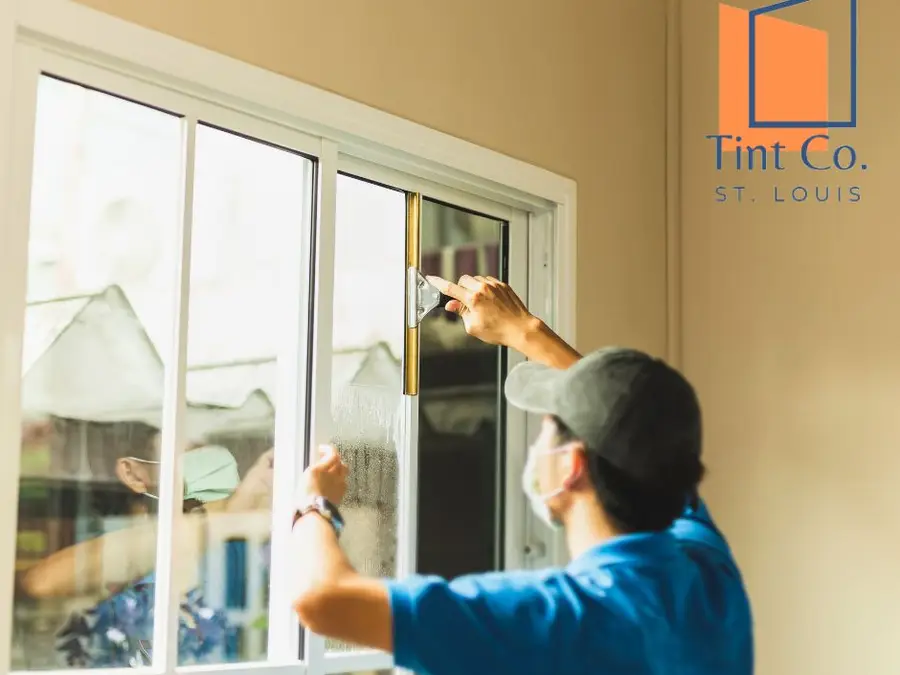
The cost of home window tinting in St. Louis comes down to how much glass you have, which film you choose, and how hard the windows are to reach and prep. A few large, easy-to-reach windows with a basic film will price very differently from a two-story great room with French-pane grids and a high-performance ceramic film. The only way to get a real number is a free on-site estimate where your glass gets measured and you see the film options in person.
Why window tinting is priced per project, not per window
People often ask for a "per window" price, and it is an understandable question. The trouble is that windows vary enormously. A small bathroom window and an eight-foot patio door are both "one window," but one takes a fraction of the film and labor of the other.
Installers generally figure the job by the square footage of glass, then adjust for the film, the access, and the prep work. That is why two neighbors with the same number of windows can get very different quotes. Below are the factors that matter most, roughly in order of how much they move the price.
1. Square footage of glass
This is the foundation of every quote. More glass means more film and more installation time. A ranch home in Kirkwood with standard double-hung windows has far less glass than a newer Chesterfield build with a wall of windows facing the backyard.
Keep in mind that you rarely need to tint every window. Most homeowners focus on the rooms that get hammered by afternoon sun, the rooms where floors and furniture are fading, or the windows that need privacy. Trimming the scope to the problem windows is the most direct way to control cost.
2. The film type and performance tier
Film is the second big variable. Residential films range from simple to highly engineered, and the price follows the technology. Here is how the main categories compare on cost:
| Film type | Relative cost | What you are paying for |
|---|---|---|
| Dyed film | Lowest | Glare reduction and privacy; modest heat control; can fade over time |
| Metallized / reflective film | Moderate | Strong heat rejection through reflection; mirror-like look by day |
| Ceramic / nano-ceramic film | Higher | Good heat rejection without a mirror look; stable color; clear views |
| Spectrally selective film | Higher | Blocks much of the infrared heat while letting most visible light through |
| Low-E (low-emissivity) film | Higher | Summer heat control plus reflecting interior heat back in during winter |
| Security / safety film | Varies by thickness | Thicker film that holds broken glass together; thicker grades cost more |
If you want the details on how these films behave, our guide to ceramic vs. dyed vs. reflective window film walks through each one. For heat problems specifically, see our solar heat control window film page, and if winter drafts and cold glass bother you, low-E window film is worth a look.
The right film is the one that solves your problem without paying for performance you don't need. A shaded north window rarely needs the top-tier film that a west-facing sunroom does.
3. Window size, shape and accessibility
Labor is a large share of any tint job, and access drives labor. Factors that add time include:
- Second-story and high windows. Transoms, clerestory windows, and two-story foyers require tall ladders or scaffolding and more careful setup.
- Skylights. Working overhead on sloped glass is slower and needs the right equipment.
- Odd shapes. Arches, half-rounds, octagons, and trapezoid windows require custom-cut film rather than straight rectangles.
- Obstructions. Built-in shelving, deep sills, heavy window treatments, or furniture that can't move easily all slow things down.
None of this means a tricky window is a bad idea. It just means the quote reflects the time involved.
4. Number of panes and French-pane grids
This one surprises people. A window divided into twelve small panes by true divided lites (the wood or metal grids common in older St. Louis homes) is cut and installed as twelve separate pieces. Each piece needs its own trimming and edge work, which takes much longer than one large sheet.
Many older homes in the City and in inner-ring suburbs like Webster Groves and University City have exactly this kind of window. If your grids sit between the glass panes or snap on the inside, the film may go on as one piece, which is simpler. We check which kind you have during the estimate.
5. Removing old film
If your windows already have film that has bubbled, peeled, or turned purple, it has to come off first. Removal means stripping the film, softening and scraping the old adhesive, and cleaning the glass thoroughly so the new film bonds properly. Older films can be stubborn, and removal on a whole house adds real time.
6. Glass type checks
Not every film is right for every pane. Dual-pane insulated units, tempered glass, laminated glass, and low-E coated glass each have considerations around heat absorption and stress. A reputable installer checks your glass type and matches a compatible film, which can narrow your options or point you to a specific film. If you are worried about your window manufacturer's warranty, read our post on whether window film voids your window warranty.
7. Decorative and custom work
Decorative and frosted window film can be a simple full-pane frost or a custom pattern, gradient, or band at a specific height. Custom designs and precise layouts take more planning and cutting time than a standard solar film install, and the quote reflects that.
How to compare window tint quotes apples to apples
Two quotes can look very different simply because they describe different jobs. Before you compare totals, make sure you are comparing the same things.
- Ask for the film spec sheet. Every quality film has published numbers. Look at visible light transmission (VLT, how much light gets through), total solar energy rejected (TSER, overall heat control), UV rejection (most quality films block up to 99%), and glare reduction.
- Confirm the same windows are included. One bid may cover every window while another covers only the sun-facing rooms.
- Check removal and prep. Is old film removal included? Is glass cleaning and prep part of the price?
- Read the warranty terms. Ask what the film warranty covers and who stands behind it. Ask us about our lifetime warranty.
- Ask who does the work. Find out whether the company installing the film is the one you are talking to, and who to call if something needs attention later.
A lower quote on a film with weaker specs is not necessarily a better deal. A higher quote on a film you don't need isn't either. The spec sheet keeps the comparison honest.
Why the free on-site estimate matters
We come to your home, measure the glass, look at the window types and exposure, and hold film samples up to your actual windows so you can see the difference in your light. You get a written quote for the exact scope, with no guessing. It is the fastest way to a real number. Request your free estimate.
Cost vs. value: what you get back
Window film is an upgrade you live with every day, so it helps to weigh what it does, not just what it costs. The main payoffs homeowners notice:
- Comfort. Fewer hot spots near west and south glass on a St. Louis July afternoon, and less glare on screens.
- Fade protection. Quality films block up to 99% of UV, which is a major contributor to fading of hardwood floors, rugs, and furniture. Our UV and fade protection film page explains more.
- Energy. Cutting solar heat gain can reduce how hard your air conditioning works. Results vary by home, and we cover it honestly in does window film lower energy bills.
- Privacy. Daytime privacy without blinds, depending on the film.
Film is also typically far less disruptive than replacing windows. If you are weighing the two, see window film vs. replacement windows.
Get a real number for your home
We install residential window tinting across St. Louis City and County, from older homes in the City and Webster Groves to newer builds in Chesterfield. Call (314) 200-0434 or book a free on-site estimate, and we will measure, show you samples on your own glass, and put the price in writing.
Frequently Asked Questions
Why won't a window tint company give me a price over the phone?
Because the biggest cost drivers are things we have to see: the exact square footage of glass, the type of glass, how the panes are divided, and whether ladders or old film removal are involved. A phone number based on a guess is usually wrong in one direction or the other. A free on-site estimate gives you a written quote based on your actual windows.
Is ceramic window film worth paying more for?
It depends on what problem you are solving. If you mainly want privacy or a bit of glare control on a shaded window, a basic film may be all you need. If you are fighting heat on west- or south-facing glass and want to keep a clear view, a ceramic or spectrally selective film usually delivers more heat rejection without darkening the room, and we show you the spec sheet so you can judge the difference.
Does removing old window film add to the cost?
Yes. Old film that has bubbled, faded or turned purple has to be stripped and the adhesive cleaned off the glass before new film goes on. How long that takes depends on the age and type of the old film and how many windows have it, so we look at it during the estimate and include it in the written quote.
Is it cheaper to tint only a few windows?
Tinting only the windows that cause problems is a smart way to control cost. Many homeowners start with the west- and south-facing rooms, a sunroom, or the windows that fade floors and furniture. We can quote individual rooms so you can prioritize and add more later.