
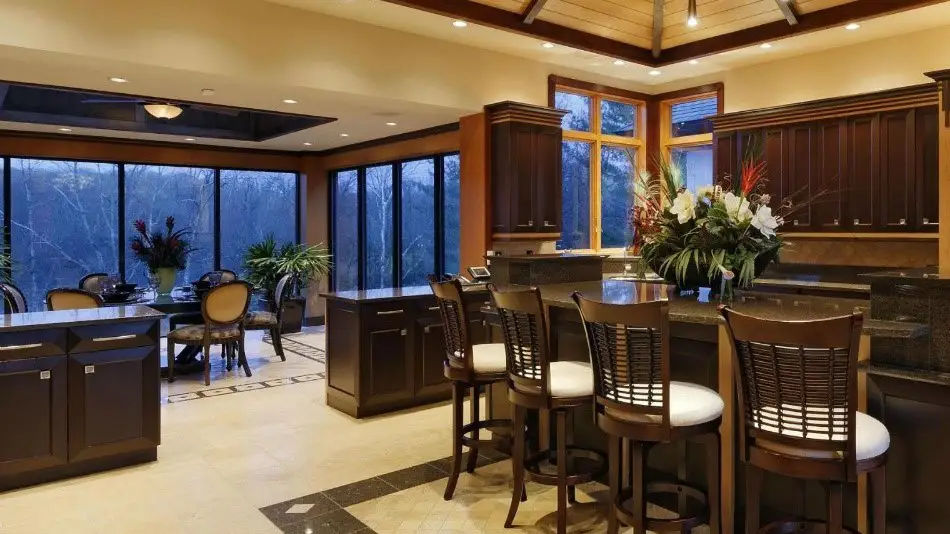
Window tinting in Ladue is mostly about protecting what is inside the house. Clear or lightly tinted residential window film blocks up to 99% of UV light to slow fading of art, rugs and wood floors, cuts heat and glare in sunrooms and glass-heavy rooms, and can add privacy on large lots. We come to your home for a free on-site estimate, test samples on your actual glass, and give you a written quote.
Why window film fits Ladue homes
Ladue was formed in 1936 when the villages of Ladue, Deer Creek and McKnight merged, and its zoning has kept the city largely residential ever since, with generous minimum lot sizes and only a limited amount of commercial land. The result is a housing stock of single-family estates: historic manor homes, mid-century residences and newer custom builds, most of them set on big, wooded lots.
Those homes share a few traits that matter for window film. They tend to have a lot of glass: sunrooms, garden rooms, great rooms with window walls, French doors to terraces and tall stair-hall windows. They are often filled with things worth protecting, like fine furniture, oil paintings, prints, antique rugs and hardwood floors. And because many sit well back from the road behind mature trees, owners usually want to keep their views exactly as they are rather than darken them.
Tree cover helps, but it does not solve everything. Deciduous canopy thins out in late fall, just as the winter sun drops lower and reaches deeper into a room. West-facing glass still takes the hard afternoon sun of a St. Louis summer. Pool houses and rooms that open onto lawns or terraces can be fully exposed. That is why we look at each side of the house separately instead of putting one film on every window.
Window film options we recommend in Ladue
UV and fade protection for art, rugs and furnishings
For most Ladue homeowners, UV and fade protection window film is the starting point. Nearly clear films block up to 99% of UV light while leaving the view and natural light almost unchanged, which suits formal living rooms, libraries and galleries where you do not want a tinted look. Because visible light and heat also play a part in fading, rooms with valuable pieces often get a film that adds some heat rejection too. We show you the spec sheet for each option so you can compare.
Heat and glare control for sunrooms and window walls
Sunrooms, conservatories and two-story great rooms are where people feel the difference most. Solar heat control window film reduces the heat and glare coming through big expanses of glass so the room stays usable on summer afternoons. Spectrally selective and ceramic-style films can do this while staying fairly light, which matters when the view of the grounds is the point of the room. Performance varies by film, so we show you the TSER, VLT and glare-reduction numbers before you choose. Our comparison of ceramic, dyed and reflective window film explains the trade-offs.
Year-round comfort with low-E film
Older manor homes may still have original single-pane or early double-pane glass. Low-E window film helps those windows hold more heat in during cold months as well as reflecting summer heat, which can be a practical middle step for owners who want to keep original windows in a historic house.
Privacy and security film
Large lots give a lot of privacy from the street, but bathrooms, pool houses, ground-floor rooms near a drive and glass entry doors can still use it. Privacy window film and decorative frosted film can obscure the view in while keeping light coming through. For glass doors and ground-level panes, security and safety window film helps hold broken glass together and makes it harder to get through quickly.
Common window film projects in Ladue
- Sunrooms and garden rooms that get too hot or too bright to use on summer afternoons.
- Clear UV film in rooms with paintings, antique rugs, upholstered furniture or wide-plank wood floors.
- Two-story great-room and stair-hall windows where blinds are impractical or unwanted.
- West-facing family rooms and kitchens with big windows, including newer custom builds with large glass openings.
- Pool houses, cabanas and terrace doors that need heat control and some privacy.
- Frosted or decorative film on bathroom windows, sidelights and glass entry doors.
- Home offices with screen glare from a large window.
Businesses and institutions in Ladue
Ladue's commercial land is limited, but it does include retail like the Ladue Crossing center on Ladue Road, plus offices, schools and clubs. The city is served by the Ladue School District, whose high school, Ladue Horton Watkins, sits on South Warson Road, and it is also home to private schools such as John Burroughs School and MICDS, along with clubs like the St. Louis Country Club and Old Warson Country Club. For storefronts, offices and other non-residential buildings, our commercial window tinting service covers glare control, heat reduction, privacy and decorative or branded film. We schedule around your hours.
How our free on-site estimate works
- We come to you. We visit your Ladue home or building by appointment, walk each room you are concerned about, and note which way the glass faces and how much shade it gets.
- Samples on your glass. We put film samples on your actual windows so you can see the color, clarity and view from inside and out.
- Measure and check the glass. We measure every pane and check the glass type so the film we recommend is compatible.
- Written quote. You get a written quote with the film options and spec sheets side by side. There is no pressure to decide that day.
If you are weighing film against new windows, read window film vs. replacement windows. For what drives the price on large homes, see how much home window tinting costs. Ask about our lifetime warranty. Our work is guaranteed to last, and if it isn't, let us know and we'll make it right. Learn more about our residential window tinting.
Nearby areas we serve
Ladue sits along Lindbergh Boulevard and Interstate 64 in central St. Louis County, so we are regularly in the neighboring communities too. We offer window tinting in Clayton for homes and office towers, window tinting in Creve Coeur, window tinting in Town and Country and window tinting in Brentwood. See every community on our service areas page, or request your free estimate.
Frequently Asked Questions
Do I need city approval to put window film on my Ladue home?
Window film is applied to the inside of the glass and does not change the structure, so it usually is not treated like a window replacement. That said, rules can change and some properties have their own subdivision or trustee guidelines. If you are considering a darker or reflective film that changes how the house looks from the street, check with the City of Ladue and your subdivision trustees first, and we can bring samples so you can see the exterior look before deciding.
Will window film protect the art and rugs in my Ladue home from fading?
Most quality window films block up to 99% of UV light, which is the biggest single cause of fading. Visible light and heat also contribute, so for rooms with valuable art, rugs or antique wood we usually suggest a film that also cuts some solar heat. No film stops fading completely, but it slows it down significantly.
Can you tint a sunroom or a two-story wall of glass in Ladue?
Yes. Sunrooms, conservatories, great-room window walls and tall transoms are some of the most common reasons people call us. We measure every pane at the free on-site estimate, note any hard-to-reach glass, and check the glass type so the film we recommend is compatible with it.
Our lot is heavily wooded. Do we still need window film?
Often yes, but it depends on the exposure. Mature trees shade a lot of glass in summer, yet many trees lose their leaves just as the low winter sun comes in at a sharper angle, and west-facing rooms can still overheat on summer afternoons. We look at each elevation during the estimate and only recommend film where it will actually help.
Will window film void the warranty on my windows?
Some window makers have warranty language about aftermarket film and some do not, so it varies by manufacturer and by glass type. We recommend checking your window paperwork, and we match the film to the glass so it is a compatible choice. Our blog post on window warranties walks through what to look for.